12 Types of Websites Explained — With South African Examples

If you’ve ever tried explaining to a web designer, freelancer, or agency what kind of website you actually need, you’ve probably run into the same problem: “website” covers a lot of very different things. A blog and an online store have almost nothing in common under the hood, even though both are technically “a website.”
Here’s a plain breakdown of the most common website types, what each one is actually good for, and a real South African example of each — so you’re working from something concrete, not a guess.
On this page:
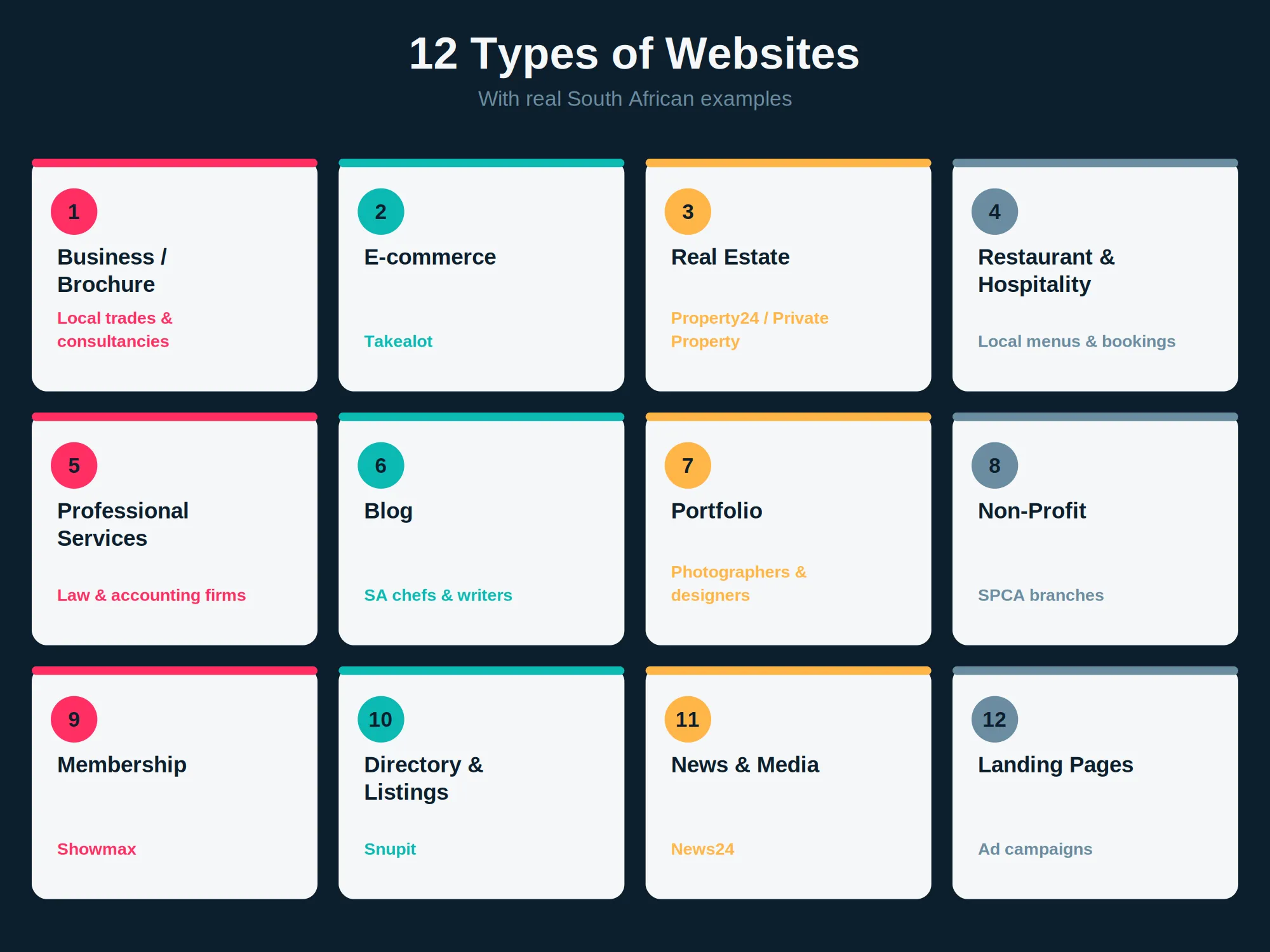
1. Business / brochure websites
The most common type by far. A brochure website lists what a business does, who it’s for, and how to get in touch — usually a home page, about page, services page, and contact page. It doesn’t sell directly online; it answers the question “who is this business and can I trust them?” before someone picks up the phone or sends a WhatsApp.
South African example: the vast majority of local trades, consultancies, and small businesses across South Africa run exactly this setup — a clean, credible online presence without the complexity of a full online store.
2. E-commerce websites
Built to sell products directly online, with product pages, a shopping cart, and a checkout process. These sites need a payment gateway, an SSL certificate, and usually shipping and returns logic built in from day one.
South African example: Takealot is the clearest local example — product listings, cart, checkout, and delivery tracking all working together as one system.
3. Real estate websites
Property listing sites live and die on search and filtering — price range, location, bedrooms, property type. They typically need virtual tours, map integration, and a direct enquiry route per listing.
South African example: Property24 and Private Property are the two names most South Africans already associate with property search, and both are built entirely around fast, filterable listings.
4. Restaurant and hospitality websites
These need to work hard across a few very different jobs at once: showing a menu clearly, taking bookings, and often linking out to delivery platforms — all while looking genuinely appetising on a phone screen, since most restaurant searches happen on mobile.
South African example: think of any local East London or Eastern Cape restaurant site that shows a current menu, opening hours, and a WhatsApp or booking link front and centre — that combination is the whole job for this type of site.
5. Professional services websites
Lawyers, accountants, doctors, consultants — for these businesses, the website’s main job is building trust before the first conversation happens. Clear credentials, a straightforward description of services, and an easy way to book a consultation matter more here than flashy design.
South African example: a local accounting or legal practice’s site is judged less on visual flair and more on whether a stressed-out visitor can immediately find “do you handle my problem” and “how do I contact you.”
6. Blog websites
Regularly updated, usually written in a more personal voice than a business page. Blogs can stand alone or sit inside a business website (like this one) to build topical authority and answer the questions potential customers are actually searching for.
South African example: plenty of South African chefs, travel writers, and small business owners run blogs alongside their main offering specifically to show up for the questions their audience is already Googling.
7. Portfolio websites
Built around one thing: showing the quality of past work. Common for photographers, designers, architects, and other visually-driven service providers, where the work itself does most of the persuading.
South African example: a local photographer or interior designer’s site that’s mostly full-bleed images with minimal text is a textbook portfolio site — the images are the pitch.
8. Non-profit websites
Non-profit sites need to build a case for a cause, usually paired with a donation or volunteer-signup function. Payment security matters here just as much as it does for e-commerce, since donations run through the same kind of payment gateway.
South African example: local NPOs and animal welfare organisations — an SPCA branch site is a familiar version of this: cause, current projects, and a donate button, all clearly signposted.
9. Membership websites
These sites gate content or services behind a login, usually tied to a subscription. They need user accounts, a payment system for recurring billing, and some kind of member dashboard.
South African example: Showmax is a familiar local example of the membership model — pay to access, log in, and the content sits behind that login.
10. Directory and listing websites
These aggregate many businesses or listings in one searchable place — think job boards or service marketplaces. They rely heavily on good filtering, verified listings, and keeping spam registrations out.
South African example: Snupit is a well-known local example — a directory connecting service providers with people searching for them, filtered by category and location.
11. News and media websites
Built to publish frequently updated content at volume — articles, breaking updates, multimedia. These sites are usually optimised heavily for search and built to handle high traffic spikes.
South African example: News24 is the obvious local reference point — constant publishing, strong internal search, and a layout built entirely around scannability.
12. Landing pages
A single-purpose page built around one campaign, product, or offer — no navigation menu, no distractions, just a clear call to action. These typically work alongside a paid ad campaign or an email send.
South African example: any local business running a Facebook or Google ad campaign for a specific promotion, pointing to a single page instead of their full site, is using a landing page correctly.
Frequently asked questions
How many types of websites are there?
There’s no single official number — many of these types overlap. A restaurant site is technically also a business website; an online store with a blog is both e-commerce and a blog. The 12 above cover the vast majority of what South African businesses actually need.
Which type of website is right for my business?
Start with what you actually need visitors to do. If you’re selling products directly, you need e-commerce. If you’re building trust before a phone call or consultation, a business or professional services site is usually enough to start.
Can one website be more than one type?
Yes, and most are. A restaurant site is a business website with a menu and booking function layered in. A photographer’s site is often part portfolio, part business site. The “type” is really about which function is doing the heavy lifting.
Do I need a different type of site as my business grows?
Often, yes. Many businesses start with a simple brochure site and add e-commerce, membership, or directory functionality later as the business itself grows into needing it — see our guide on logo design pricing for how this kind of phased investment plays out with branding too.
Not sure which type fits your business?
If you’re still not sure which of these fits what you’re building, get in touch and we’ll talk it through — no pressure, no jargon. You can also see our full pricing breakdown on our website cost guide.
Examples referenced are used for illustrative purposes to describe common website categories and are not affiliated with or endorsed by Dot Digital.