How Much Does Logo Design Cost in South Africa? (2026 Guide)
Logo design in South Africa typically costs between R500 and R25,000+
For most small and growing businesses, a professional logo sits in the R950–R4,500 range — enough for custom concepts, proper vector files, and full ownership, without paying agency-scale prices for work you don’t need yet.
Search “logo design price South Africa” and you’ll find quotes anywhere from R100 specials to R25,000 brand systems, with very little explanation of what actually separates them. That range isn’t agencies being cagey — it reflects genuinely different products being sold under the same name.
Here’s what you actually get at each price point, where the real risk sits with ultra-cheap options, and where our own pricing fits into the wider South African market — with real numbers, not vague ranges.
On this page:
- Logo design pricing tiers in South Africa
- What other South African agencies actually charge
- Where our pricing sits
- Why the cheapest option often costs more later
- What this looks like in practice
- Frequently asked questions
Logo design pricing tiers in South Africa
| Tier | Price range | What it’s suited for | What you’re actually getting |
|---|---|---|---|
| DIY & AI tools | R0 – R350 | Testing an idea, hobby projects | Template-based, no ownership guarantee, usually PNG only |
| Entry-level freelancers | R500 – R1,500 | Very early-stage micro-businesses | Basic design, limited concepts, file formats often incomplete |
| Professional SME standard | R950 – R4,500 | Established and growing small businesses | Custom concepts, full vector files, real ownership |
| Agency & brand studios | R5,000 – R25,000+ | Scaling brands needing full identity systems | Strategy, naming, full brand guidelines, multi-application design |
Most South African small businesses fall into the third tier — professional enough to look credible to customers and suppliers, without paying for the strategic brand work that large, multi-location companies actually need. This breakdown isn’t just our own read of the market either — it lines up closely with how Google’s own search results currently categorise South African logo pricing, which is a useful sanity check if you’re trying to work out where a quote you’ve received actually falls.
What other South African agencies actually charge
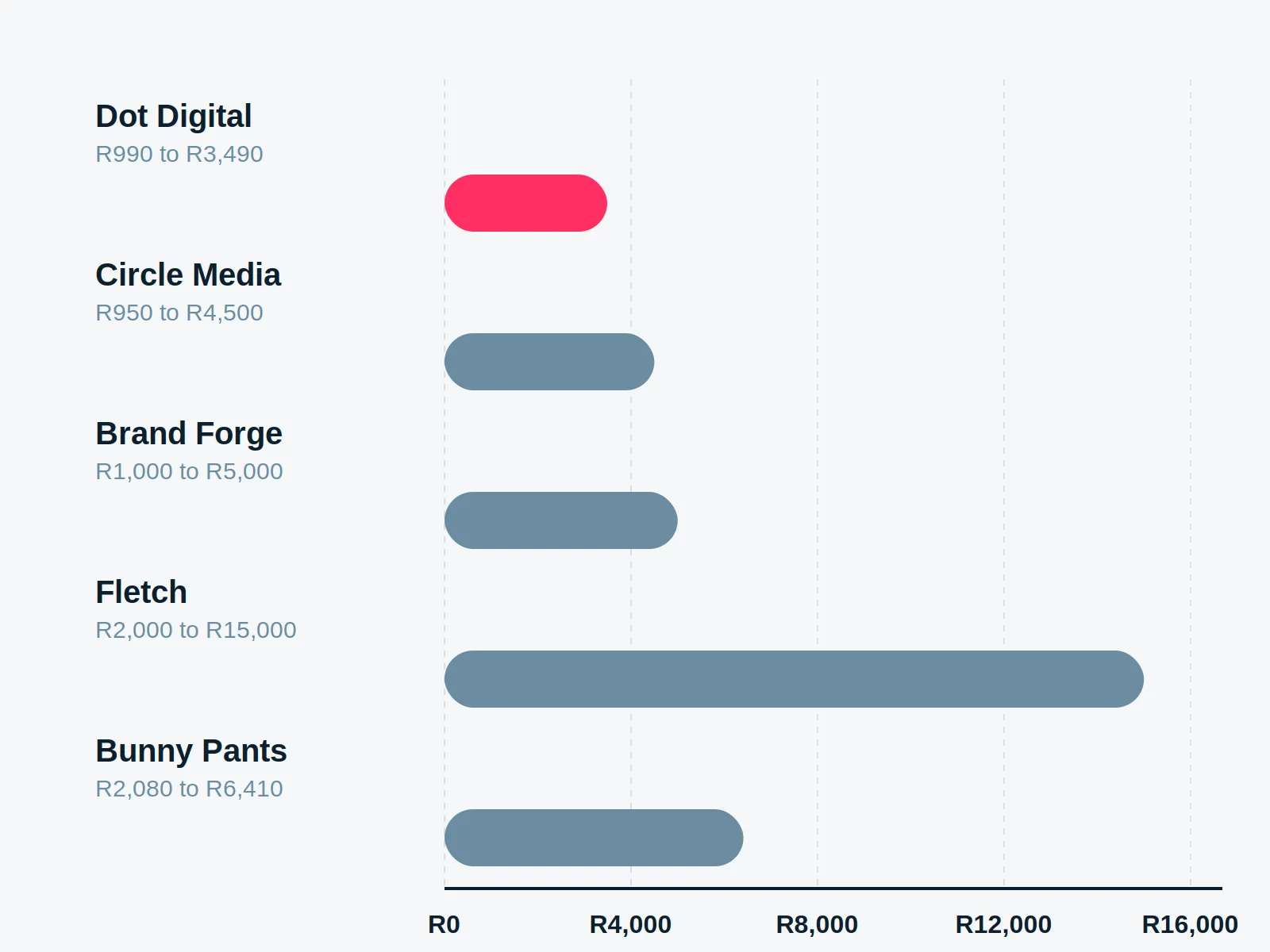
It’s worth seeing where our pricing sits against the rest of the market, rather than taking our word for it in isolation. Here’s how our tiers compare to a few published South African ranges as of 2026:
| Agency | Price range |
|---|---|
| Dot Digital | R990 – R3,490 |
| Circle Media (Cape Town) | R950 – R4,500 |
| Brand Forge (Cape Town) | R1,000 – R5,000 |
| Fletch | R2,000 – R15,000 |
| Bunny Pants | R2,080 – R6,410 |
Our tiers sit at or below every one of those ranges, for comparable deliverables: custom concepts, full vector files, and real ownership. That’s a deliberate choice, not a coincidence — we’d rather stay accessible to small businesses than price ourselves into the agency bracket.
Where our pricing sits
We keep our logo design pricing at the accessible end of that professional tier, on purpose:
- Starter Logo — R990. 2 concepts, 2 rounds of revisions, PNG and JPG files with a transparent background, basic colour palette.
- Small Business Package — R1,990 (our most popular option). 3 concepts, unlimited revisions, full vector files (AI, EPS, SVG), colour palette in hex and CMYK, font recommendations, and a basic brand guide.
- Corporate Identity Package — R3,490. Everything in the Small Business package, plus a letterhead, business card design, email signature, and a full brand style guide.
All three tiers include full ownership once the final payment clears, and turnaround is typically 5–7 business days. You can see the full breakdown, including exactly what’s in each package, on our logo design page.
Why the cheapest option often costs more later
The real risk with ultra-cheap or free logos isn’t the upfront price — it’s what’s missing from the file you actually receive.
Most free and entry-level tools hand you a PNG. That’s fine for a website or a social media profile picture. It falls apart the moment you need to:
- Print signage or a shopfront banner — a PNG stretched beyond its original size turns blurry or pixelated
- Embroider a uniform or cap — embroidery services need a vector file (AI, EPS, or SVG), not a pixel-based image
- Hand your logo to a printer for business cards or packaging — most print shops will reject a low-resolution PNG outright
At that point, a lot of business owners end up paying a designer anyway — just to redraw a logo they thought they’d already paid for, from scratch, because the original file can’t be recovered as a vector. That’s the hidden cost cheap logo pricing rarely mentions.
There’s a second, less obvious risk with AI-generated and template-based logos specifically: most of them are built from shared design libraries — the same icons, shapes, and layouts available to everyone else using that tool. Because the components aren’t exclusively yours, these logos generally can’t be trademarked. For a business you’re planning to build long-term, that’s worth knowing before you commit to one as your permanent mark, even if the upfront cost looks appealing.
What this looks like in practice
The right logo investment depends on how your business actually uses its branding, not just your budget. A few real examples:
Real estate and property businesses need a logo that works across For Sale boards, property portal thumbnails, and printed materials — all at different sizes, all needing to stay sharp. A vector-based logo isn’t optional here; it’s the difference between a professional board and a stretched, blurry one on a busy road.
Restaurants and hospitality businesses apply their logo to menus, packaging, signage, and social media — often all within the first few weeks of opening. A template-based logo tends to look like several other local restaurants using the same free tool, which undercuts the “you haven’t seen this before” impression a new venue wants to make.
Professional services — lawyers, accountants, doctors, consultants — lean on their logo as a quiet trust signal before a client has spoken to them at all. A generic or dated-looking mark can undercut credibility before the first meeting even happens.
Frequently asked questions
Is a R990 logo good enough for my business?
For many early-stage South African businesses, yes — provided it includes clean design and the correct file formats for your immediate needs. As the business grows, many owners upgrade to a fuller identity package rather than starting over.
What file formats do I actually need?
At minimum, PNG for digital use and vector files (AI, EPS, or SVG) for anything that might be printed, signed, or embroidered. Vector files scale to any size without losing quality — a PNG doesn’t.
Why do some logos cost R10,000 or more?
Higher-end pricing usually reflects a full brand identity project — strategy, naming input, typography systems, and a complete brand guideline document — not just the mark itself. That’s a different product to a standalone logo.
Do I need a professional logo if I’m just starting out?
The moment you register a company, launch a website, or hand out a business card, your logo is representing you. It doesn’t need to be expensive, but it does need to be usable — the right file formats matter more than the price tag.
How much should I actually budget?
For most South African small businesses, R950–R4,500 covers a genuinely professional result. Below that range, expect real trade-offs in file formats and originality. Above it, you’re typically paying for brand strategy work that matters more once you’re scaling than when you’re starting out.
Ready to move forward?
If you’d like a straightforward quote or want to talk through which package fits your business, reach out on WhatsApp and we’ll walk you through it — no pressure, no jargon. You can also see full package details on our logo design page.
Pricing current as of 2026. Individual project scope can affect final cost — get in touch for a quote specific to your business.