How Much Does a Website Cost in South Africa?
A website in South Africa costs from about R1,500 for a basic one-page site to R100,000 or more for a large custom build. Most small businesses pay between R5,000 and R25,000 once-off for a professional website, with the average five-page site landing around R6,600. On top of that, budget roughly R300 to R1,500 a month for hosting and maintenance after launch.
That’s the honest one-line version. But “it depends” doesn’t help you set a budget, so this guide breaks it down properly: what a website actually costs by type, what you really get at each price level (and what you don’t), the running costs nobody warns you about, and a straight comparison of building it yourself versus hiring a freelancer or an agency.
I’m Tristan — I build websites for a living, from East London. So yes, I have a stake in this. But this guide is written to help you understand the market, not to funnel you into my packages. Where a cheaper route genuinely makes more sense for you, I’ll say so.
Website Design Cost in South Africa by Type
The biggest single factor in what a website costs is what kind of website it is. A one-page “here’s my number” site is a completely different job from a 500-product online store. Here are the realistic 2026 ranges, based on published pricing across dozens of South African web designers and agencies:
| Website type | Typical SA price (once-off) | Who it’s for |
|---|---|---|
| One-page / landing page | R1,500 – R8,000 | Sole traders, events, campaigns |
| Starter brochure site | R3,000 – R12,000 | New small businesses needing a presence |
| Small business site | R5,000 – R25,000 | Established businesses wanting enquiries |
| Business / lead-generation site | R8,000 – R60,000 | Businesses that live off the site’s leads |
| E-commerce store | R7,500 – R80,000 | Anyone selling products online |
| Corporate / enterprise site | R16,000 – R150,000+ | Large organisations, multiple stakeholders |
| Custom platform / web app | R18,000 – R250,000+ | Booking systems, portals, bespoke tools |
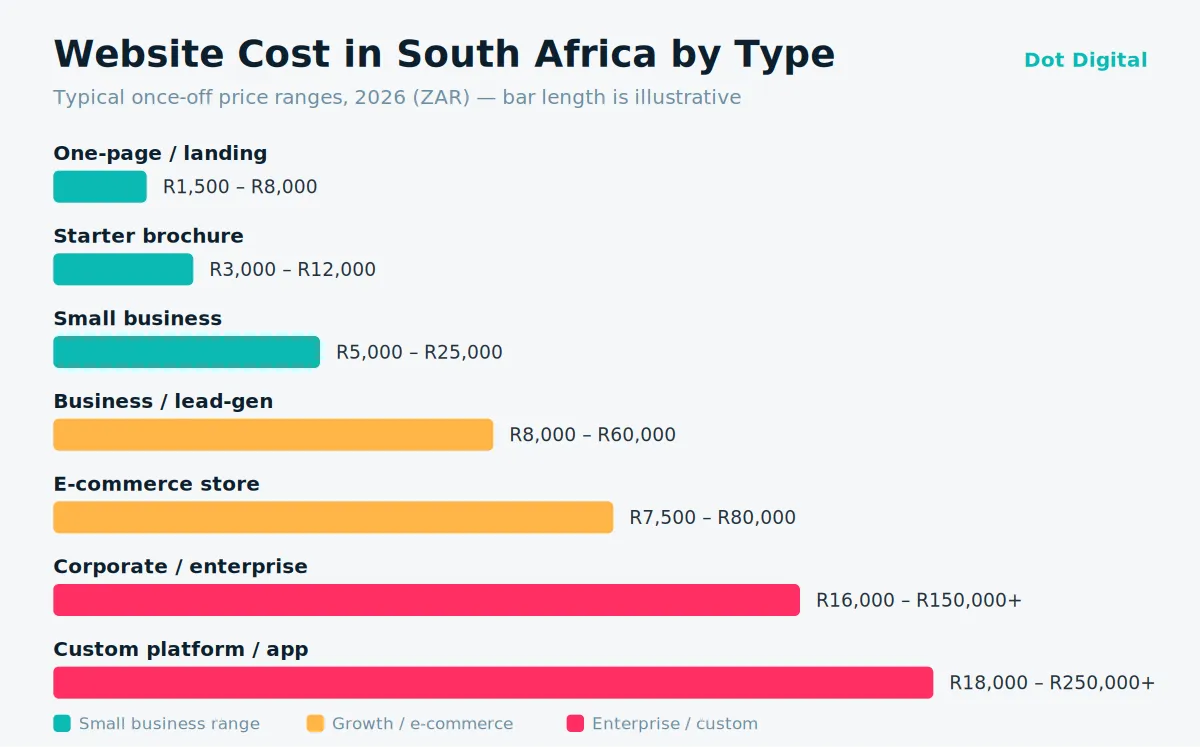
Most South African small businesses land in the R5,000 to R25,000 band. If you’re quoted well above that for a standard business website with no special functionality, it’s fair to ask exactly what you’re paying for.
Worth knowing: prices also shift by city. Cape Town runs the most expensive — the average five-page site there is around R11,500 — while Johannesburg sits nearer R7,600, and coastal centres like East London and Gqeberha tend to be lower again. That gap isn’t about better work. It’s overheads: city agencies with offices and account managers pass those costs on.
What You Actually Get at Each Price Level
Ranges are useful for a ballpark, but the real question is what your money actually buys. Here’s what’s typically included — and, just as importantly, what’s usually left out — at each tier.
R1,000 – R5,000: freelancer or DIY template
At this level you’re working with a freelancer or a DIY builder like Wix or Squarespace with light customisation. Typically included: a template design with your branding, two to four pages, a basic contact form, and mobile responsiveness built into the template. Usually not included: meaningful SEO, custom design, Google Business Profile setup, any functionality beyond a contact form, or post-launch support. Best for sole traders and micro-businesses that just need something online. Not the right choice if Google visibility or lead generation actually matter to you.
R5,000 – R15,000: proper small business website
This is where professionally built websites really begin in South Africa, and it’s where most small businesses should be looking. Typically included: three to ten professionally designed pages, a WordPress build you can edit yourself, mobile-responsive design, basic on-page SEO, contact and WhatsApp integration, and Google Business Profile setup. Usually not included: advanced SEO architecture, custom functionality beyond standard forms, email marketing integration, or CRM connections. A solid entry point that establishes credibility and captures direct enquiries.
R15,000 – R40,000: business / lead-generation website
Here the website becomes a genuine business development asset rather than an online brochure. Typically included: ten to twenty pages, advanced SEO with schema and page-speed work, custom enquiry and booking forms, newsletter and CRM integration, and custom functionality tailored to the business. Usually not included: e-commerce (that’s normally separate scope), ongoing SEO campaign management, and copywriting or photography. The right tier for established businesses competing hard for organic search traffic.
R7,500 – R80,000: e-commerce store
Online stores are categorically more complex than brochure sites, which is why they start higher and climb fast. Typically included: a product catalogue, shopping cart and checkout, secure payment gateway (PayFast, Yoco, Peach), order management, user accounts, shipping configuration, and cart-abandonment emails. Usually not included: product photography and descriptions, ongoing inventory management, and warehouse or ERP integrations. Budget more for hosting and maintenance here too — e-commerce sites cost more to run than standard ones.
R18,000 – R250,000+: custom platform or web app
This covers bespoke functionality a standard build can’t deliver — client portals, booking platforms, marketplaces, complex integrations. Pricing at this level is almost always quoted after a detailed scoping process. Only necessary when your requirements genuinely can’t be met by a well-built professional website. For most businesses, it’s expensive overkill — so be honest about whether you actually need it.
Why Web Design Quotes Vary So Much
If you’ve had two quotes for “the same website” that differ by R20,000, it’s because the scope underneath them is different. These six factors account for almost all the variation in website design cost.
1. Number of pages
A three-page site costs less than a ten-page site — more pages means more design and build time. Know how many you actually need before requesting quotes; it’s the fastest way to make quotes comparable.
2. Custom vs template design
A template speeds up the build and lowers the price. A custom design, built around your brand, takes longer and costs more. Both can look professional — the difference is uniqueness and flexibility, not quality.
3. E-commerce functionality
Adding a shop changes the scope significantly — product pages, cart, checkout, payment integration, stock management all have to be built and tested. WooCommerce on WordPress is generally the most cost-effective route for South African small businesses, with no monthly platform fees.
4. Who supplies the content
Supply your own copy and images and the build is faster and cheaper. Need copywriting or photography arranged and that adds cost. Most quotes assume you provide content unless stated — so if you don’t have it ready, factor it in.
5. Features and integrations
Booking systems, membership areas, calculators, CRM connections — every added feature adds development time. Stick to what you genuinely need at launch; you can add features later once the site is earning its keep.
6. POPIA compliance
Every South African website that collects personal data needs a privacy policy and cookie consent to comply with POPIA. It’s a legal requirement, not an optional extra — non-compliance carries serious penalties. A good builder includes it as standard; if a quote doesn’t mention it, ask.
DIY vs Freelancer vs Agency: How Much Each Really Costs
Most cost guides skip this part, because most are written by agencies who’d rather you didn’t weigh the alternatives. Here’s the honest version of each route — including when it’s the right one.
Do it yourself (Wix, Squarespace, Shopify)
Cost: roughly R0–R600 a month, ongoing. Cheaper upfront and capable of looking decent if you have time and an eye for it. The catch: you’re renting, not owning — stop paying and the site disappears. Costs never end, the SEO ceiling is lower, and you do all the work. Best for sole traders, side hustles, and testing an idea before investing properly.
Hire a freelancer
Cost: roughly R3,000–R20,000 once-off, or around R300–R500 an hour. The sweet spot for most small businesses — a custom, owned website without agency overheads. The risk is variability: freelancers range from excellent to unreliable, and if one disappears mid-project you’re stuck. Vet them properly — check their portfolio and ask to speak to a past client.
Use an agency
Cost: roughly R15,000–R150,000+ once-off. You get a team — designers, developers, SEO specialists, a project manager — and that structure costs money. Worth it for a large organisation with complex needs. Usually overkill for a plumber who needs a five-page site, where you’re subsidising their offices and salaries. Best for bigger businesses and complex builds.
There’s a fourth route between freelancer and agency: a specialist solo developer — someone who works alone (no agency overheads) but runs it as a proper business (none of the freelancer reliability risk). You get owned, custom work at freelancer-level pricing with agency-level accountability. That’s the model I run — but the point stands whoever you choose.
How Much Do Web Designers Charge in South Africa?
When work is quoted by the hour rather than as a fixed project, South African web design rates typically run R250 to R950 an hour. Entry-level freelancers sit at the lower end; established agencies with strategy and UX teams charge the premium. The average across the market is around R500 an hour. Specialised development — custom PHP, Python, complex API work — usually falls between R300 and R600 an hour.
Most builds, though, are quoted as a fixed project price rather than hourly. Hourly billing is normally reserved for out-of-scope additions and post-launch changes. If you’re quoted an hourly rate with no total, ask for a realistic estimate of hours up front so there are no surprises.
How Much Does a Website Cost Per Month to Run?
The build price is only half the picture. A website isn’t a once-off purchase like a printed brochure — it has to stay online, updated, and secure. Here’s what that costs in South Africa:
| Ongoing cost | Typical SA price | What it covers |
|---|---|---|
| Hosting | R60 – R1,500/month | Keeps the site online. Shared hosting at the low end, managed hosting at the high end. |
| Domain renewal | R90 – R300/year | Your .co.za or .com address. Some builders include this with hosting. |
| Maintenance | R300 – R1,500/month | Updates, backups, security, small content changes. Optional but recommended. |
| SSL certificate | Often free / included | The browser padlock. Usually bundled with hosting now. |
Realistically, budget R300 to R1,500 a month to run a professional small business website properly after launch. Do your own updates on basic hosting and you’ll stay near the bottom; want it fully managed and you’ll be near the top. Over a year, that’s roughly R3,600 to R18,000 in running costs on top of the build — worth planning for from the start.
How Much Should a Website Cost for Your Business?
Cutting through the ranges, here’s what I’d tell a friend to budget depending on where they’re at:
- Just starting or testing an idea: R1,500–R5,000, or a DIY builder at a few hundred a month. Don’t overspend before you’ve proven demand.
- Established small business wanting enquiries: R5,000–R12,000 for a proper 5–10 page site. This is where most businesses should be.
- Selling products online: R7,500–R20,000 for a solid store, climbing with product count and integrations.
- Larger business or complex needs: R15,000+ and genuine agency territory, where the extra structure earns its cost.
If you’re in the middle two — which most South African small businesses are — the honest advice is simple: don’t pay agency prices for a straightforward site, and don’t go so cheap you’re rebuilding within a year. Somewhere between R5,000 and R15,000, with a builder who owns their work and includes SEO, is the value zone.
For full transparency: I publish my own prices openly rather than hiding them behind a quote form — small business sites from R4,500, no monthly build fees, technical SEO included. If you want to see exactly what a professional website costs with me, my website design pricing page lays it all out, including hosting and first-year totals. And if a different route suits you better, everything above still stands.
Frequently Asked Questions
How much does web design cost in South Africa?
Web design in South Africa costs from about R1,500 for a basic one-page site to R100,000+ for a large custom build. The average five-page website works out around R6,600, and most small businesses pay between R5,000 and R25,000 once-off for a professional site. Hourly rates, when used, average about R500 an hour.
How much should a website cost for a small business?
Budget R5,000 to R25,000 once-off for a professional small business website, with most businesses spending around R8,000 to R12,000 for a functional, mobile-friendly build. Add roughly R300 a month or more for hosting and maintenance afterwards.
How much does it cost to create a website yourself?
Using a DIY builder like Wix, Squarespace, or Shopify, expect roughly R0 to R600 a month, ongoing. There’s no big upfront fee, but you never stop paying and you’re renting rather than owning the site. It’s the cheapest way to start, with a lower SEO ceiling and all the work on you.
How much is a website in South Africa per month?
To run a professional website, budget R300 to R1,500 a month all-in after launch — that covers hosting (R60 to R1,500 depending on service level), optional maintenance (R300 to R1,500), and domain renewal (R90 to R300 a year). Monthly “website package” deals from R180 to R800 exist too, but with those you’re usually renting rather than owning the site.
What is the price of a 5-page website in South Africa?
A five-page website typically costs between R5,000 and R15,000 once-off, with the market average around R6,600. The lower end is a template-based build; the upper end includes custom design, on-page SEO, and a proper content structure. Platform choice and features like WhatsApp chat and Google Maps integration all affect the final price.
How much does an e-commerce website cost in South Africa?
E-commerce websites typically start around R7,500 and run to R80,000 or more, depending on product count, payment gateway needs, and design complexity. The market average for a basic online store is around R8,400. A WooCommerce store on WordPress is usually the most cost-effective route for a small business, with no monthly platform fees unlike Shopify.
How much does a website cost per year to maintain?
After the build, running a professional website costs roughly R3,600 to R18,000 a year — hosting, optional maintenance, and domain renewal combined. If you manage the site yourself on basic hosting, you’ll be at the low end; a fully managed setup sits at the high end.
Why are website quotes so different from each other?
Because “a website” isn’t one thing. Page count, custom versus template design, e-commerce functionality, who supplies the content, and how many integrations you need all move the price — two quotes for what looks like the same site can differ by R20,000 because the scope underneath differs. Always compare what’s included, not just the total at the bottom.
Is it cheaper to use a freelancer or an agency?
A freelancer or specialist solo developer is almost always cheaper than an agency for a standard small business website — roughly R3,000 to R20,000 versus R15,000 and up — because you’re not paying for offices, account managers, and a team. Agencies earn their higher price on large, complex builds, not simple brochure sites.
Prices in this guide reflect the South African market in 2026 and are indicative — every project is different. Figures are drawn from published pricing across dozens of South African web designers and agencies.